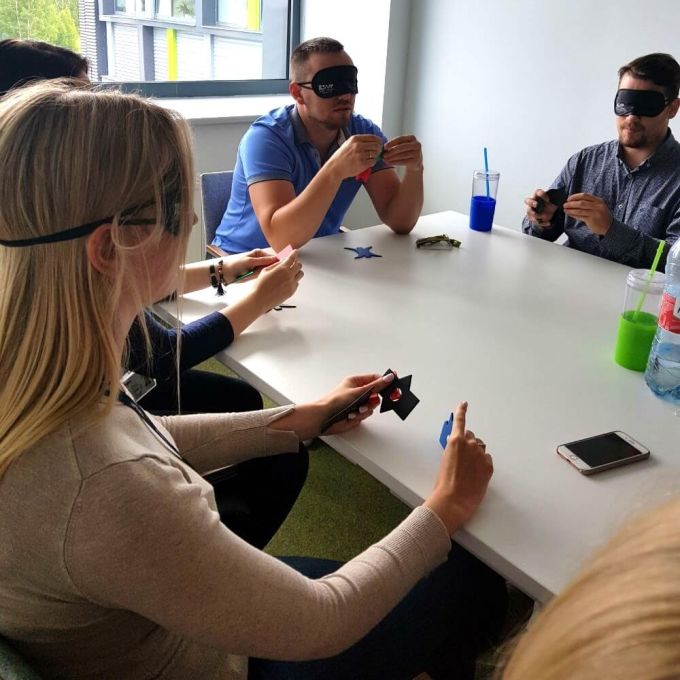
Colourblind started life many years ago as a way of training Air Traffic Controllers to be effective communicators in situations where the actors involved do not have a shared visual reference point; the ATC has a screen and a view of the airport, the pilot has a set of instruments and a view of the open sky. It proved so effective in achieving this desired learning outcome that the facilitators involved in the training programes began to use Colourblind elsewhere - and, all across the globe, that experimental approach to using it has continued. We're continually being delighted by stories of facilitators finding new and Innovative ways of using what is, in effect, a very simple tool. For us it's a concrete demonstration of the versatility we build into every new tool.
It's an interesting case study in that running a Colourblind session doesn't really change - the mechanics of the activity are simple, but the facilitator needs to be consistent in their application if they are going to get full learning value. The variations come in the before and after stages - how you introduce the activity and define its objectives, then how you review it and extract the appropriate learning.
Colourblind is a powerful and insight-raising tool in situations where your purpose is integrating two or more populations; e.g. an internal restructuring that requires teams to be integrated, or a merger that means bringing together corporate cultures, or a new employee intake. The different populations may have subtly (or not so subtly) different elements of language, terminology, behaviour and ethics, and Colourblind can be used to illustrates the strengths and weaknesses in this situation. Review questions such as "How did you settle on a name for this piece?", "What was the process for making a decision about how to get to a result?" and "What did you do or say to get clarity about how the group were intending to do?" will give participants a better understanding of how they are going to navigate the integration process.
The Colourblind activity is based on a principle of 'distributed cognition' i.e. each participant has a more or less equal share of the knowledge and materials needed to achieve a successful result. This makes it an excellent intervention into a team dynamic which shows imbalance e.g over-dominance by one or more characters, or individual contributions being ignored, or simply having 'noisy' and 'quiet' people. The activity will grind to a halt if any individuals withhold their contribution, or the behaviour of the rest of the group makes them feel unable to make their contribution. This may automatically lead to the group themselves recognising the situation and adapting their behaviour to something more inclusive - in which case exploring this needs to be a key element of your review. If this doesn't happen there's a case calling a temporary halt to the activity, bringing the situation to the attention of the group and asking a questions such as "How do you need to change the way you're tackling this exercise to allow every individual to contribute?" or "What's getting in the way of your progress towards a successful result here?"
The final case I want to explore is the pleasure of highlighting, and applauding, diversity in a group. Making the participants conscious of just how much of a strength this can be is a powerful endorsement of individuality. How people describe Colourblind pieces, how they work towards shared terminology, who are the ideas people, who are the organisers, who brings a cavalier approach, and who are the careful - all of these can be brought out in review. The real learning comes fro projecting these individual characteristics onto the workplace job of the team and exploring roles and responsibilities based on aptitude rather than position.
I hope that these brief suggestions offer some different ways of thinking about how you use Colourblind. There are always other, novel, ways of using the tool - and we're always keen to hear about people getting creative with it.