


Experiential Learning
Experiential Learning is a term that is often used, incorrectly, to describe any kind of learning that involves practical, usually team-based, activities. “We’re going to do some experiential learning - they will be building a spaghetti tower.”
It might be practical: it isn’t necessarily experiential learning. In the USA, experiential learning is frequently used to describe the prior learning that applicants for academic programmes bring with them from previous work or life experience and for which they might, for example, receive exemption from units of the programme - the ‘accreditation of experiential learning.’
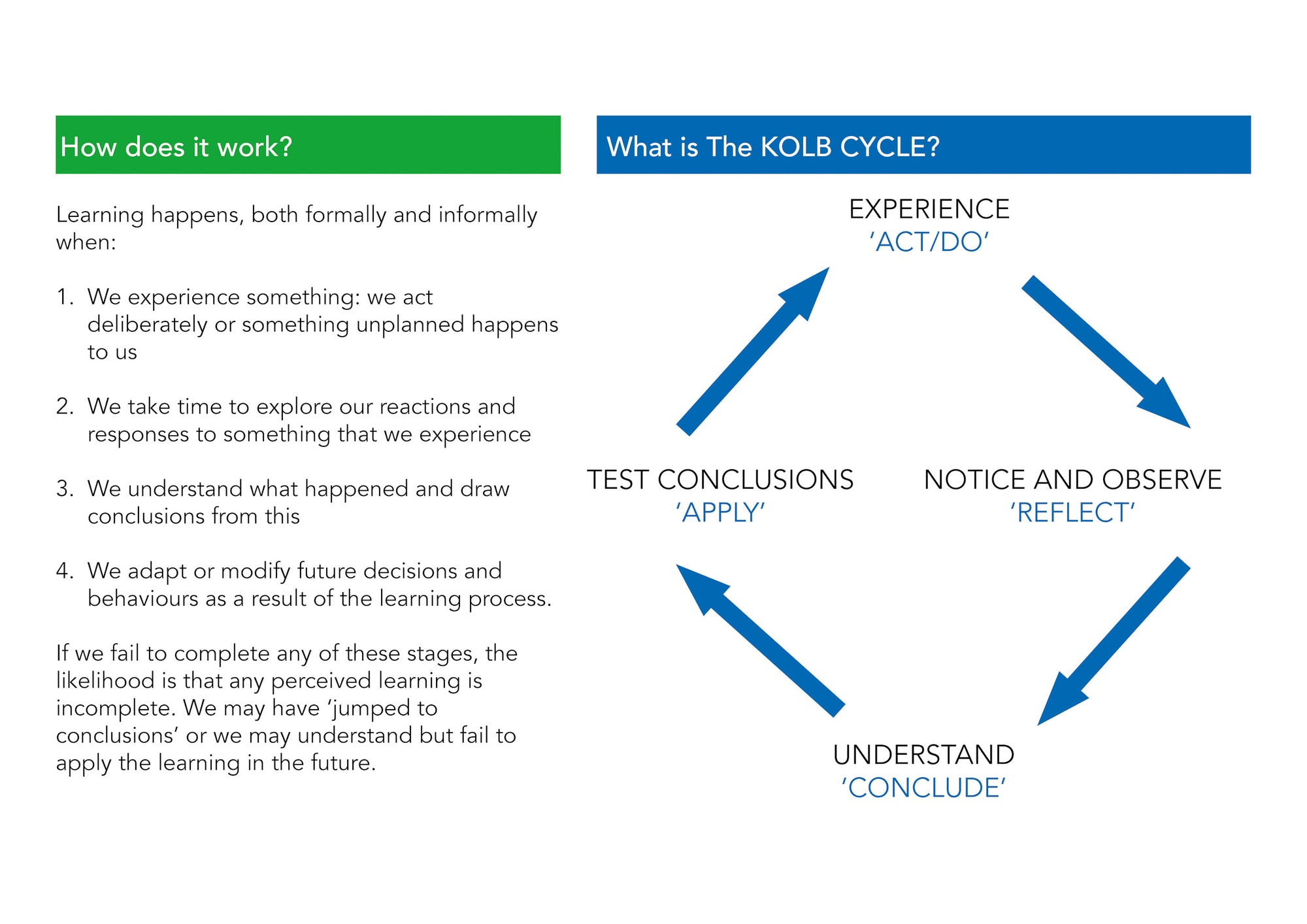
At RSVP Design we use the term to refer to a very specific form of learning, which is outlined in the work of David Kolb and best shown illustrated in the ‘Kolb Experiential Learning Cycle’ in the diagram to the left.
It is a 4-stage process which offers the potential for learning from any experience that happens to us.
Experiential Learning in a Workplace Learning Context
The Power of In-Person Experiential Learning
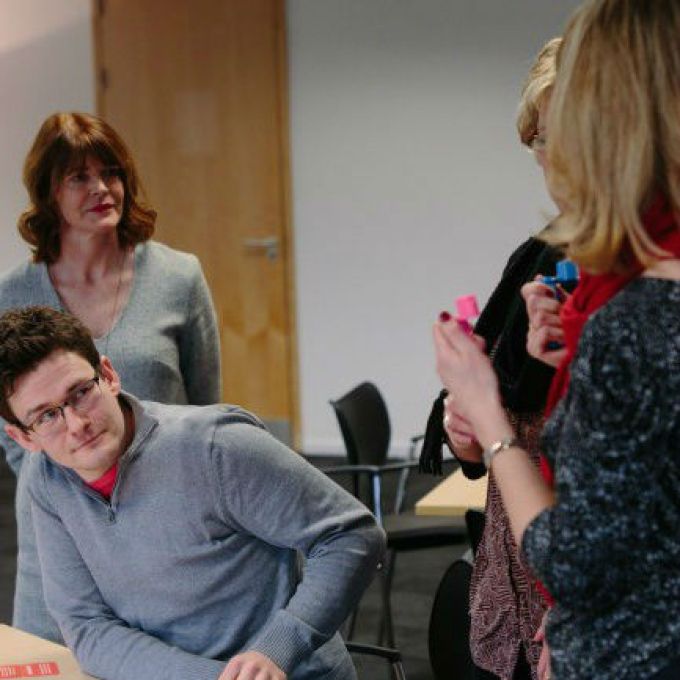
In the context of workplace-based development, true experiential learning is a highly specific, focused approach that uses physical products, games, activities, and challenges to unlock better engagement and learning effectiveness.
Instead of traditional training where there is a lot of "telling" before the "doing," physical learning games and simulations make the entire experience about sensitisation (to a behaviour or effect) or practice (rehearsal in a safe space). When learners use physical tools to solve problems, strategise, or collaborate, they engage in a holistic experience where they think, feel, and act simultaneously.
By bringing tangible, interactive activities into the training room, we tap into the essential elements needed for learning to occur:
- Motivation & Engagement: Decades of psychology research show that people are goal-oriented, and games, puzzles and challenges naturally provide well-defined goals, immersive "flow," and the motivation to triumph.
- Immediate Feedback: Games offer continual, immediate feedback. A poor decision results in an immediate consequence within the game, causing players to instantly adjust their behaviour and refine their performance.
- Relevant Practice in a Safe Space: Learning games are designed to replicate real-world workplace constraints and challenges without real-world risk.
- Appropriate Levels of Challenge: Adult workplace learners need practical learning that is relevant to their immediate goals and is self-directed


The Language Barrier: "Experiential Learning" vs. "Gamification"
Before exploring how RSVP Design transforms team performance, it helps to clarify the terminology—especially for our visitors from the USA.
In the USA, the term "experiential learning" is frequently used in tertiary education to describe the prior learning or life experience that applicants bring to academic programs. In an educational context, the term is commonly used as a catch-all phrase to describe any non-teaching or non-lecture content.
Because the educational sector has heavily adopted "experiential learning" to mean life experience or non-lecture coursework, the US corporate training sector often relies on the terms "gamification" or "serious games" to describe workplace-based learning instead. However, at RSVP Design, we draw a very distinct line between gamification and focused, workplace-based experiential learning.
Experiential Learning vs. Gamification: What’s the Difference?
While both approaches use elements of play to engage learners, their mechanics and end goals are fundamentally different:
- Gamification typically relies on the addition of game-like elements to traditional learning or tasks. This often includes the use of points, badges, and leaderboards (PBLs), which are highly motivating to players seeking recognition or achievements. Gamification is excellent for driving engagement through external rewards, repetition, and immediate feedback.
- Workplace-Based Experiential Learning, on the other hand, is a highly specific approach that uses physical products, activities, and challenges to fundamentally change behaviour rather than just reward it. Instead of focusing on points, learners are placed into a low-risk, simulated world where they can safely experience purposefully-designed challenging experiences, but also rehearse and refine new approaches and behavioural responses. It is about creating a safe environment for challenge and experimentation so teams and individuals can explore existing patterns of thought and behaviour, increasing their self-awareness.
RSVP Design is a trusted partner for impactful experiential exercises in leadership development in our courses at IMD. RSVP Design’s experiential exercises provide participants with hands-on, immersive experiences, enabling active engagement and profound reflection. By simulating real-world scenarios, their exercises allow participants to practice and refine their leadership skills in a safe and supportive environment. What sets RSVP Design apart is their ability to suggest exercises to meet our course objectives and participant profiles. On the rare occasion when they do not have an exercise to hand, they take the time to understand our challenges and work with us to design exercises that directly address our needs – RSVP Design’s amazing “T Trade” exercise was the product of collaboration between RSVP Design and IMD faculty.


Ann & Geoff are remarkable people! They bring great professionalism, enormous experience, unique skills plus genuine passion to what they do. At the same time as inspiring and enabling progress with the groups, they bring good humour and people leave feeling very positive. They have both made a tremendous contribution to Caplor Horizons, a charity focused on supporting other charities, specialising in strengthening organisational effectiveness. I have no hesitation in recommending them.

