6
Gartner TEN key world of work changes forecast
0 Comments | Posted by graham in Learning Design, Learning Tools & Resources
In a press release to promote their upcoming Content and Collaboration Summit 2010 (London, UK, September 15-16) Gartner Research forecast 10 key changes in the nature of work through to 2020: “Work will become less routine, characterized by increased volatility, hyperconnectedness, ’swarming’ and more,” said Tom Austin, vice president and Gartner fellow. By 2015, 40 percent or more of an organization’s work will be ‘non-routine’, up from 25 percent in 2010. “People will swarm more often and work solo less. They’ll work with others with whom they have few links, and teams will include people outside the control of the organization,” he added. “In addition, simulation, visualisation and unification technologies, working across yottabytes of data per second, will demand an emphasis on new perceptual skills.”
We agree with the predictions, and see it as a continuation of change we are already seeing in organisations; and with it will come some major challenges for L&D/OD departments. Here are the ten key changes Gartner forecast, and where we think L&D professionals should be considering a response.
1. De-routinization of Work – the obvious response here is the de-routinization and individual personalisation of training. We look forward to when “Here is the list of available training courses” is accepted as an outdated and wasteful use of trainer and delegate time & resources. I suspect the public sector in the UK has some way to go on this …
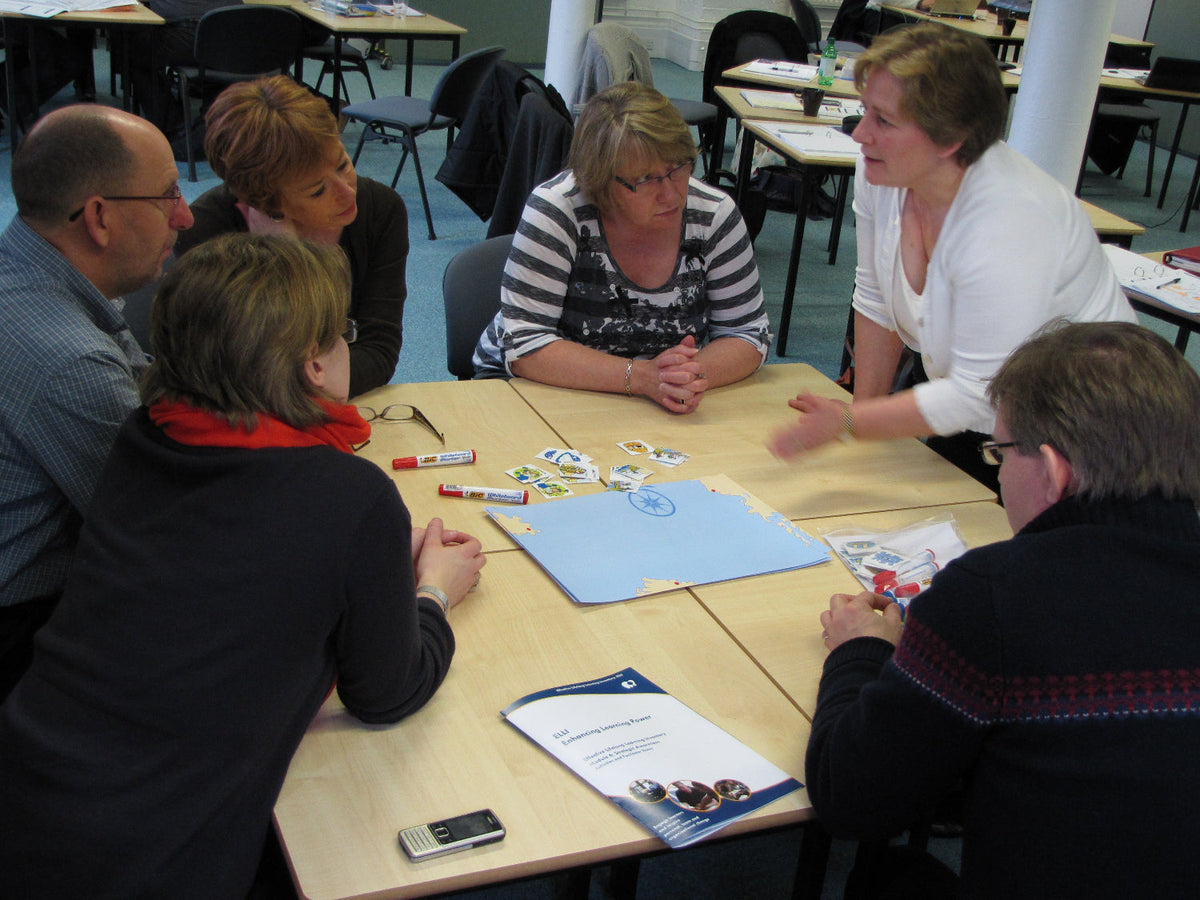
2. Work Swarms – workers need more insight into how they might work effectively with others who think differently or have different problem-solving approaches etc. Tools like HBDI or Effective Life-long Learning Inventory will be useful in being able to quickly work effectively in ’swarms’ of people you don’t know well.
3. Weak Links – formal and informal networking will become an even more important skill in the future, and not just for salespeople! Consider how and where social and business networking sites can and should be used during worktime. Is time spent networking on Facebook helping to build weak links, or just chatting with friends? Will updating my blog be considered as vanity or essential to developing these weak links?
4. Working With the Collective – Perhaps ‘influencing’ will become the most desirable skill of any business leader as we move to a position where ‘the collective’ replaces any internal hierarchy? This suggests more prefered ‘right-side’ thinking style in the HBDI model than the traditonal ‘left-side’ found in many management positions today.
5. Work Sketch-Ups – ‘Designing-in-flight’ or ‘managing in ambiguity’ requires a very different set of skills and behaviours than that typically suggested by teaching through a ‘case-study’ method. How will our Business Schools and academics respond? Will we move to more activity-based learning facilitation than ‘teaching’?
6. Spontaneous Work – This suggests creating the type of corporate culture where this is not only desired but encouraged. How do you build this culture? Contrast this with today where most ‘leaders’ set the work agenda – how do you lead/manage people who develop their own work activities and priorities?
7. Simulation and Experimentation – of course we believe that activity-based learning provides the ideal ’synthetic’ environment to experiment and simulate behaviours. That’s why we create tools to help organisations build their learning environments!
8. Pattern Sensitivity – See Ann’s forthcoming book: Pattern Making, Pattern Breaking
9. Hyperconnected – in a hyperconnected world there is probably no time for formal contracts and agreements. Does this suggest an increase in the importance of ‘Trust’ and a requirement to better understand how to build and maintain it? Is it hopefully the end of long-winded tender processes?
10. My Place – how do we deliver training at ‘My Place’ (the workplace may be virtual, may physically be at home, or indeed may change on a daily basis)? Will it be more ‘edutainment apps’, delivered outside of the normal working hours, paid for by discerning individuals (who want to build their learning power) out of their own pocket (or personal learning account)?
31
Best practice in the design of learning environments: Doctoral Thesis!
1 Comment | Posted by graham in Learning Design, Learning Experiences, Learning Tools & Resources
Everyone here at RSVP Design and our clients, partners and suppliers would like to congratulate our colleague Geoff Cox on his recent Doctoral award and his new title of Dr. Cox! Outlined below is some further information on Geoff’s Thesis, and you can contact him for more information on geoff@rsvpdesign.co.uk
Back in 2003, RSVP Design was created with a real sense of mission around utilising, and developing best practice in the design of learning environments. It was recognised at a very early stage that if this mission was to be achieved there was an urgent need to define exactly what “best practice” looked like. It was at that time that Geoff began his research, aimed at making available to designers, practitioners and buyers of learning events a set of guidelines that would help them to discern the best from the rest!
The early stages of the research were plagued with problems. Different terminology on different sides of the Atlantic, a shocking lack of published material relating to the design dimension of learning, and in particular the extent to which RSVP Design needed to demonstrate the unique value of experiential learning: each an impediment to progress. By 2004 a comprehensive examination of published material brought the conclusions:
a) There were no existing guidelines for the design of experiential learning environments
and
b) We were going to have to write our own
and
c) Any thoughts of this being a quick exercise were now out of the window!
That began six years of action research that started with some initial, tentative guidelines that Geoff put forward and asked our facilitation team to report back on. The guidelines were revised, based on their feedback, and he moved to the next piece of design using the new guidelines. This cycle was repeated on multiple occasions, with groups from business school executives to factory supervisors, each time adding to our knowledge of how the emerging guidelines needed to be revised and applied. The research journey was punctuated by some interesting insights, for instance when it was determined that the guidelines were equally applicable to learning environments that were designed to address the needs of young people, and when the guidelines were used successfully for the first time with electronic simulations as the experiential activity.
So finally, (in 2010!) Geoff has defended his Thesis and is now Dr. Cox. We will shortly be publishing an Executive Monograph of his research on the RSVP Design website and we believe that this will be a key contribution to what we believe to be current best practice in the field of learning design.
·It is an open and transparent statement of how RSVP Design creates experiential learning environments.
·It offers clients who are commissioning experiential learning events a language to define their requirements.
·It offers clients who are buying experiential learning events a way of discerning / interrogating the quality of the designs that they are being offered.
17
ELLI: measuring and developing learning power
2 Comments | Posted by graham in Learning Design, Learning Tools & Resources
Effective Lifelong Learning Inventory (ELLI)
One of the most exciting pieces of applied research we’ve come across recently has come from The University of Bristol. We think it adds huge value to our understanding of how people learn – and how we can support them in individual and organisational learning. We have been working with the research team for more than a year and we’re delighted that we are amongst the first people in the UK to be accredited to use ELLI in our learning design, coaching and trainer training. We are working closely with ViTaL Partnerships and the University of Bristol to help them to develop applications of ELLI beyond schools-based learning and into learning and development in business, and we’re really excited about our plans to launch a variety of applications soon for use in commercial (non-academic) organisations.
ELLI is:
- A well-researched set of ideas about how people learn most effectively
- A self-assessment instrument to aid self-analysis, diagnosis and strategy
- A tool to empower people to bring about change, individually and together
The ELLI research team at Bristol investigated what it is about some people that makes them effective lifelong learners. Seven dimensions of ‘learning power’ emerged, via factor analysis, each with elements of ‘thinking, feeling and doing’. The seven dimensions are:
changing and learning – a sense of myself as someone who learns and changes over time;
critical curiosity – an orientation to want to ‘get beneath the surface’;
meaning making – making connections and seeing that learning ‘matters to me’;
creativity – risk-taking, playfulness, imagination and intuition;
learning relationships – learning with and from others and also able to manage without them;
strategic awareness – being aware of my thoughts, feelings and actions as a learner and able to use that awareness to manage learning processes;
resilience – the readiness to persevere in the development of my own learning power.
The ELLI profile gives powerful insights into individual and organisational learning patterns. It creates opportunities for in-depth coaching and mentoring conversations that focus not just on what people need to learn, but how they can build their learning power. It allows learning designers to consider their chosen delivery methods and match them against the needs of their learners. It allows an exploration of available learning tools and technologies and helps individuals to develop personal learning strategies that will support them in achieving their learning goals.
If you are interested in learning more about ELLI, we will shortly be delivering both an introductory one-day workshop and an extended (additional 2 days) accreditation workshop that would allow licensed trainers/coaches to then use ELLI within their own organisations & clients. For more information please contact us on +44 141 561 0387.
11
Games as management practice fields?
0 Comments | Posted by graham in Learning Design, Learning Experiences, Learning Tools & Resources
I read the recent Chartered Management Institute Review which stated some interesting and disturbing statistics for UK managers:
CMI recently questioned UK managers to find out which aspects of management they thought they were best at. Of the 2,158 managers polled, almost half (44 per cent) said they excelled at managing people. Twenty-one per cent were target-busters, 19 per cent believed they were strongest at managing themselves and just 14 per cent felt they were born to lead.
CMI has since put those perceptions to the test by inviting UK workers to use a specially-developed self-diagnostic tool to work out where their strengths and weaknesses lie. The results strongly contradict managers’ perceptions, revealing that, in practice, UK managers are best at getting results (41 per cent) and strong leadership (37 per cent). Just 14 per cent of the 6,056 people who used the tool excelled at people management and a paltry eight per cent proved to be best at managing themselves.
See http://www.hrreview.co.uk/articles/hrreview-articles/hr-strategy-practice/half-of-managers-misjudge-their-workplace-performance/10058
I wondered when I read that where do:
1. Most managers go to find out more about their own learning strengths/preferences and personality/thinking preferences? As little of this is taught to most undergraduates where else can ‘ managers’ get this insight, except through their organisation’s L&D team-building or other activities? Should this be mandatory on all undergraduate courses?
and
2. Managers (new or experienced) go to ‘practise’ their management skills? So much of what we see in corporate/organisational L&D is about presenting theories, models, competency frameworks, performance monitoring etc and less about offering these delegates the chance to practise new skills or behaviours. Group learning through experiential activities is a great way to offer people a non-contentious and safe ‘practice field’ for a wide rnage of management and ’soft skills’ rehearsal – but how do we get employers to provide more of it?
30
Developing creativity in learning organisations
0 Comments | Posted by ann in Learning Experiences, Learning Tools & Resources
I recently came across this interesting article that suggests that creativity is in crisis!
http://www.newsweek.com/2010/07/10/the-creativity-crisis.html
Creativity involves both divergent and convergent thinking. Divergent thinking opens up new options, ideas and possibilities, disregarding barriers and resource limitations. Convergent thinking then takes these multiple options and works with them, refining them until a useful outcome is produced. Many organisations emphasise convergent thinking but limit divergent thinking. My suspicion is that this is a response to the fear and risk aversion that has developed as a result of a culture of blame and litigation: divergent thinking inherently has risk and failure built in. Standardisation, measurement and control serve a purpose – but the downside is that they diminish creative thought.
If it is true that creativity is in crisis (and according to a recent IBM survey, creativity is an absolutely vital leadership skill) we really need to focus on strategies for re-building creative thinking as a core part of our education system and professional development. Fortunately, the evidence cited in the article also suggests that creativity can be learned. So, what can we, as facilitators of learning, do to enhance the creative abilities of our learners?
Here are some of my thoughts:
1. First re-engage people with the belief that they can be creative. Creativity isn’t just for artists and musicians – it’s the lifeblood of engineers, scientists and researchers too.
2. Help people to understand that creativity is not just about getting flashes of inspiration – it’s about making meaning from connecting ideas together, seeing new patterns in things and viewing existing things from new perspectives.
3. Encourage people to challenge their assumptions. Help them to see how they can block creativity by holding on to past experience that limits them: “This won’t work because it didn’t before…” or “Stick with this because we know it works”.
At RSVP Design we have a number of tools and workshops that focus on building creativity: we love the activities in our Breakthrough Thinking workshop that aim to do just this. Have a look at the workshop materials you can buy for your own use and enjoy getting creative!
http://rsvpdesign.co.uk/shop/breakthrough-thinking-workshop-p-31.html
15
Do some cultures (and trainers) avoid activity based learning?
0 Comments | Posted by graham in Learning Tools & Resources
I travelled to Vienna last week, and met with a number of trainers from Central & Eastern Europe. I enjoyed our discussions about varying levels of use and application of experiential and activity based learning techniques in various locations. One particular discussion however rather disturbed me – I met a Polish trainer and showed her some of our metaphor-based tools such as Images of Organisations and problem-based activities such as Seeing the Point. She maintained that she did not like any of them and questioned how useful such tools could be in training. My concern was not that she disliked RSVP Design activites but that she seemed to hold such strong personal feelings about what is ‘right’ without even considering what her ‘trainees’ might need or want. How often do trainers let their personal likes and dislikes colour the training material they design and use? Is there a particular cultural reason why experiential or activity-based learning would not be popular in Poland?
15
‘Icebreakers’ and introductions: don’t waste your time!
0 Comments | Posted by ann in Learning Experiences, Learning Tools & Resources
There are times when a trainer or facilitator ask me for an ‘icebreaker’ and it makes me shudder. I’ve seen some great training delivery in my time – and I’ve sat through some pretty awful sessions too. I think most learners have made up their minds about what a session is going to be like after the first few minutes and that decision is often made on the basis of the introductory activity – or lack of it. So I’m quite prepared to stand on my soapbox and claim that getting your introductory activities right is a crucial part of your learning design process. Any old ‘icebreaker’ just won’t do!
Face-to-face time in learning is becoming increasingly precious. Yet very often, the process of introducing the course, the participants and ‘breaking the ice’ takes a disproportionate amount of time and doesn’t add value or move towards the learning objectives. And I’m sure we’ve all sat through the lengthy ’round table introductions’ that we could have done informally in a few minutes if we’d had the opportunity to get up and move! So here’s the challenge – find a means of introducing yourself and the group that delivers new insights and learning and ‘tunes people in’ to the core content of your training session.
Here are a few ideas:
1. Use what I call ‘people bingo’. Create a grid of 25 squares. In each one, write a statement about something that it would be genuinely useful to know eg. ‘Someone who is currently working on Project X’, ‘Someone who has experience of Y,’ ‘Someone who has experience of working with a competitor’, ‘Someone who has qualification Z’. Choose things relevant to your group and objectives. Give everyone a copy of the grid – the ‘bingo’ sheet – and give them 10 minutes to circulate and collect as many different signatures in the boxes as they can. They’ll need to talk to each other!!
2. Use imagery. RSVP Design’s ‘Images of Organisations’ and ‘Images of Customer Service’ are great examples of how carefully selected images can generate useful and relevant early discussion and focus people on the theme of the training or to benchmark how they are feeling at the start of an event.
3. Begin with an activity that gets people thinking and talking about the content of the programme. Our ‘Challenging Assumptions’ puzzle is a quick and simple way of introducing people to themes around problem-solving, innovation and change management. In just a few minutes they experience an activity that they want to talk about and, as they do so, the introductions happen naturally in a relevant learning context.
4. On a ‘technical’ training programme, use a group activity that gets a group working together and also identifies what they already know of the material they will be learning about. RSVP design’s ‘Learning Loops’ is a great example – a quick, multiple-choice question game that can be tailored to use your own content and then provides an excellent way of testing pre-training and post-training knowledge, whilst also building your learning group as they problem-solve together.
For more ideas and more information about any of the activities suggested above, have a look at the website or drop us a line!
3
In a world of increasing complexity how do we help managers and leaders?
2 Comments | Posted by graham in Learning Design, Learning Tools & Resources
I’ve been reading and watching a lot of interesting stuff recently. For example there is a wonderful piece of an animated, annotated presentation from Dan Pink on motivation here: 
http://www.youtube.com/watch?v=u6XAPnuFjJc
There’s also a really interesting new leadership study from IBM here: http://www-935.ibm.com/services/us/ceo/ceostudy2010/index.html
However while both give some examples of why what we’ve previously thought about motivation and leadership might be wrong, and tell us what we ought to be doing, neither give the L&D community much insight into HOW we help people get there. As an engineer by training I’m more interested in how to apply theories than the basic research of how they came to be ‘agreed’. While I reckon that some great individuals will be able to demonstrate the behaviours and skills described as ‘ideal’ , I also reckon that most of us need to learn new skills, unlearn old behaviours, and practise to get better. So how do we do that? What practise fields do people use to make sure these theories and concepts move from just being an understanding at an intellectual level to a level where they they are understood by heart as well as head, and demonstrably improve performance?
3
Independent Business Development Professionals Wanted
0 Comments | Posted by graham in Learning Design, Learning Experiences, Learning Tools & Resources
RSVP Design is fortunate to have built-up an extremely strong portfolio of learning tools, learning design capability and learning experiences that we can now provide to a wider range of clients. With our strong global associate network we have a fantastic capability to deliver anything from a single workshop to a global leadership programme. If you are an independent business development professional and wish to add our IP to your sales portfolio, please contact graham@rsvpdesign.co.uk
27
People learn best when they’re having fun… don’t they?
1 Comment | Posted by geoff in Learning Design
One of the key things I look for when I’m delivering learning events is whether the people around me appear to be having fun. It’s the same with designing new learning environments. Part of my “Is this good design?” checklist is whether it offers both facilitator and learner the opportunity to enjoy the learning process.
I don’t know where this “fun’s important” approach came from but perhaps it’s a reaction to the long, mind-numbingly boring classroom hours that characterise much of my own education. I never wanted a repeat of those experiences so why should I inflict them on anybody else? Wherever it came from, I can’t remember a time when “ People learn best when they’re having fun” wasn’t a part of my professional vocabulary.
Today I was browsing the subject of the Personalisation of Learning when I came across a fascinating chapter by Manfred Spitzer. The chapter is part of the OECD book Personalising Education (2006) and is called Brain Research and Learning Over the Life Cycle. As the title suggests the subject area is what we know about the function of the brain and how this should translate into educational practice aimed at different age groups.
There’s a lot of good stuff in this chapter, but the real “Eureka!” moment for me came when I read the part that deals with the way we attach emotions to what we learn, and how this affects our ability to remember it (always a pretty important feature of any learning design!).
In short, when something is learned in an environment that allows us to attach positive emotions to it, we store the memory in one part of our brain, the hippocampus: where the associated emotion is negative we store the memory in a different part of the brain, the amygdala. The learning in our hippocampus then transfers over time to the brain cortex where long-term memory happens. Conversely the amygdala is the part of our brain where fast learning and future avoidance of unpleasant events is controlled – learning what not to do. Thus our reaction to the associated memory is not about creatively applying it to our future lives – it’s about never getting into the situation of ever having to apply it!
Not at all what we want as learning designers.
So it seems that, intuitively, I was right all along – people do learn best when they are having fun: and I’d say that that’s a pretty big message for anyone setting out to design any kind of learning experience.